What is a brand tracker?
A brand tracker is a quantitative research method used to measure a brand’s health, consumer perception, and competitive position over time. While a typical market research study captures a single snapshot of consumer sentiment at a point in time, a brand tracker collects data continuously (e.g., monthly, quarterly, or semiannually) to monitor trends, measure the impact of marketing efforts, and benchmark performance against competitors.
Brand tracking is frequently used by marketers, brand managers, and consumer insights teams across virtually every industry. It is applicable in any scenario where a business needs to understand what consumers think about their brand, how likely they are to purchase, how the brand stacks up against the rest of the category, and monitor how all of these metrics are shifting over time.
How does brand tracking work?
Brand tracking works by continuously surveying a representative sample of consumers and asking them a consistent set of questions. This consistency, i.e. asking the same questions in exactly the same way, wave after wave, allows researchers to analyse how brand metrics move over time, and to make confident distinctions between a genuine trend and a one-off fluctuation.
A standard brand tracking survey measures what is commonly referred to as the brand funnel, a sequential set of metrics that reflects how consumers move from awareness through to preference:
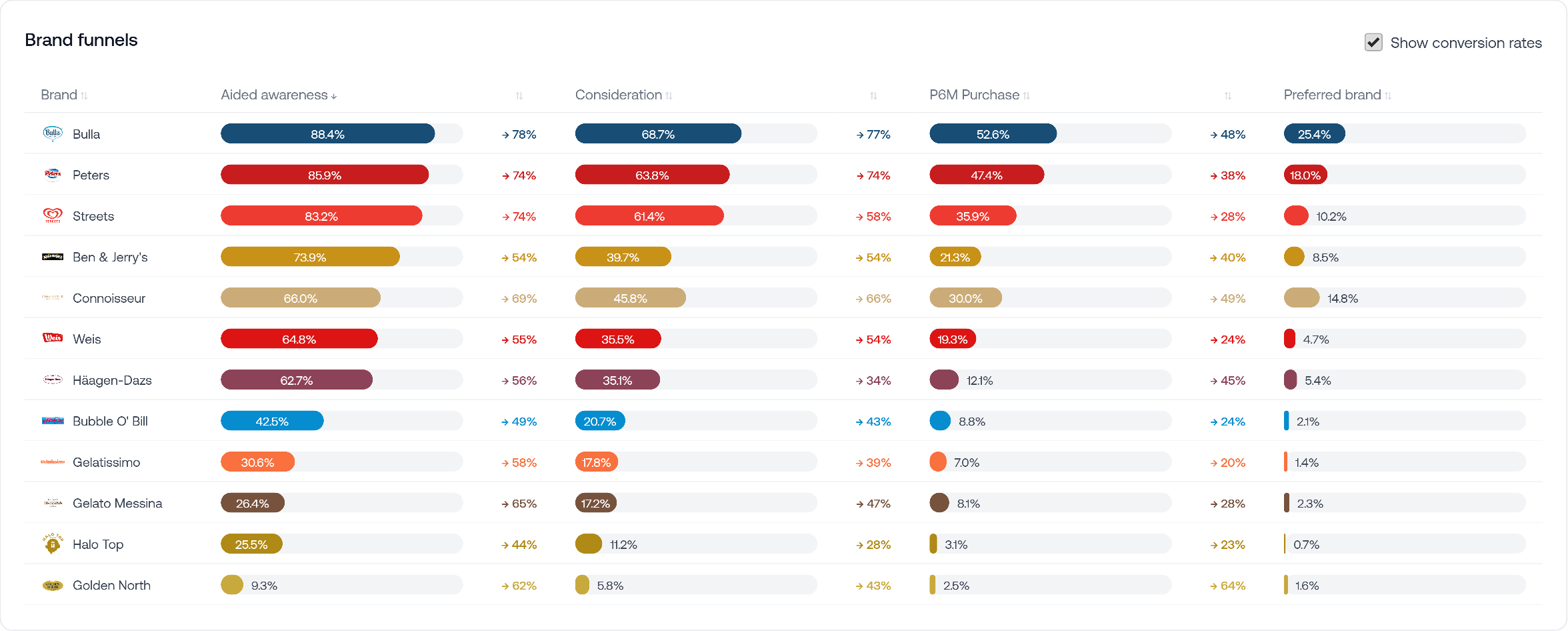
While customized questions are often added, the core funnel metrics usually include:
- Awareness: What percentage of the market knows your brand exists? This can be measured in two ways: Unaided Awareness (spontaneous recall) and Aided Awareness (recognition when shown a list of brands).
- Consideration & Usage: Who is actually buying or intending to buy? Surveys typically measure past behaviour (e.g., P12M: “in the past 12 months”) and may also measure forward intent (e.g., N12M: “in the next 12 months”). Together, these metrics reveal the size and shape of a brand’s customer base relative to competitors.
- Brand Diagnostics: These are follow-up questions used to identify the specific strengths and weaknesses of a brand. For example, respondents who are aware of your brand might be asked to indicate how much they agree that your brand is “safe,” “premium,” or “innovative.”
By gathering these metrics wave over wave, businesses can track brand growth or decline and detect long-term shifts in consumer sentiment across the whole category.
Why do businesses need brand tracking?
Whether you are an emerging disruptor or an established market leader, brand tracking is essential for making data-driven marketing decisions rather than relying on “gut feelings”. Businesses use brand trackers to:
- Measure marketing ROI: If you launch a major advertising campaign, a brand tracker will show you exactly how much your Aided Awareness or Consideration increased in the months following the launch.
- Benchmark against competitors: A tracker doesn’t just measure your brand; it measures the whole category. You can monitor your share of voice and see if a competitor’s new product launch is stealing your mindshare.
- Identify genuine trends: Continuous tracking helps distinguish genuine, long-term brand growth from temporary spikes driven by seasonal demand, promotional activity, or short-term market disruptions. This longitudinal perspective is something no single-wave study can provide.
Historically, the cost of running a continuous tracking survey restricted this methodology to enterprise corporations with six-figure research budgets. Today, modern research platforms have made enterprise-grade tracking highly accessible to businesses of all sizes.
Who takes part in brand tracking surveys?
The accuracy of any brand tracker hinges entirely on the quality of its respondents. To ensure insights accurately reflect the real world, researchers must source a high-quality, representative sample. Typically, participants are recruited from extensively vetted global panel networks. Importantly, a typical brand tracker does not survey the exact same individuals every time.
To ensure the sample matches the demographic composition of the target market, researchers use quota-sampling and post-survey weighting. This means adjusting responses based on key demographics, such as age, gender, region, social class, and education, using official census data as benchmarks.
Respondent quality is a serious methodological concern. If a tracker is contaminated by poor-quality responses from bots, professional survey takers, or respondents who rush through without genuine engagement, the resulting data will be highly volatile and unreliable for tracking trends.
To combat this, the best brand trackers employ multi-layered quality controls. This includes bot blocking, geofencing, prevention of repeat completions, and the automated flagging and removal of anomalous responses before the final results are calculated.
While these internal controls are essential, the gold standard for data reliability is independent, third-party validation. Brand Tracker by Conjointly meets ISO 20252:2019 (Annex A), ISO 27001:2022, ISO 27701:2019, and System and Organization Controls (SOC) 2 Type 1 and 2 standards, ensuring only high quality, real human respondents participate in our tracking studies.





Syndicated vs. custom Research
When setting up a brand tracker, businesses generally have two methodological approaches to choose from:
- Syndicated Tracking: In a syndicated setup, a research provider runs a standardized survey covering a specific market or category (e.g., Australian Banking or US Fast Food). Because the core brand funnel questions are shared across multiple clients, the cost of fielding the research is divided. This delivers efficient pricing while still allowing individual brands to insert their own private, custom diagnostic questions into the survey.
- Custom Tracking: For highly niche categories or specific business needs, a custom tracker allows a company to completely tailor the questionnaire, dictate the exact sample composition, and even import past data from previous suppliers to ensure continuity.