Australians head to the local salon, Americans reach for the clippers at home
Using this data story? Please reference the source using one of the formats below.
Conjointly. (August 2026). Australians head to the local salon, Americans reach for the clippers at home. https://brandtracker.conjointly.com/data-stories/haircut/. Retrieved .
Conjointly. "Australians head to the local salon, Americans reach for the clippers at home." Brand Tracker by Conjointly, August 2026, https://brandtracker.conjointly.com/data-stories/haircut/. Accessed .
Conjointly. "Australians head to the local salon, Americans reach for the clippers at home." Brand Tracker by Conjointly. August 2026. https://brandtracker.conjointly.com/data-stories/haircut/. Accessed .
Conjointly ran the same set of haircut questions in the August 2026 Brand Tracker wave in Australia (n = 1,447) and the United States (n = 1,380), asking in both countries how often people get their hair cut, where they usually go, why they choose that place, and, for those who cut their own hair at home, what brand of clippers or trimmers they use.
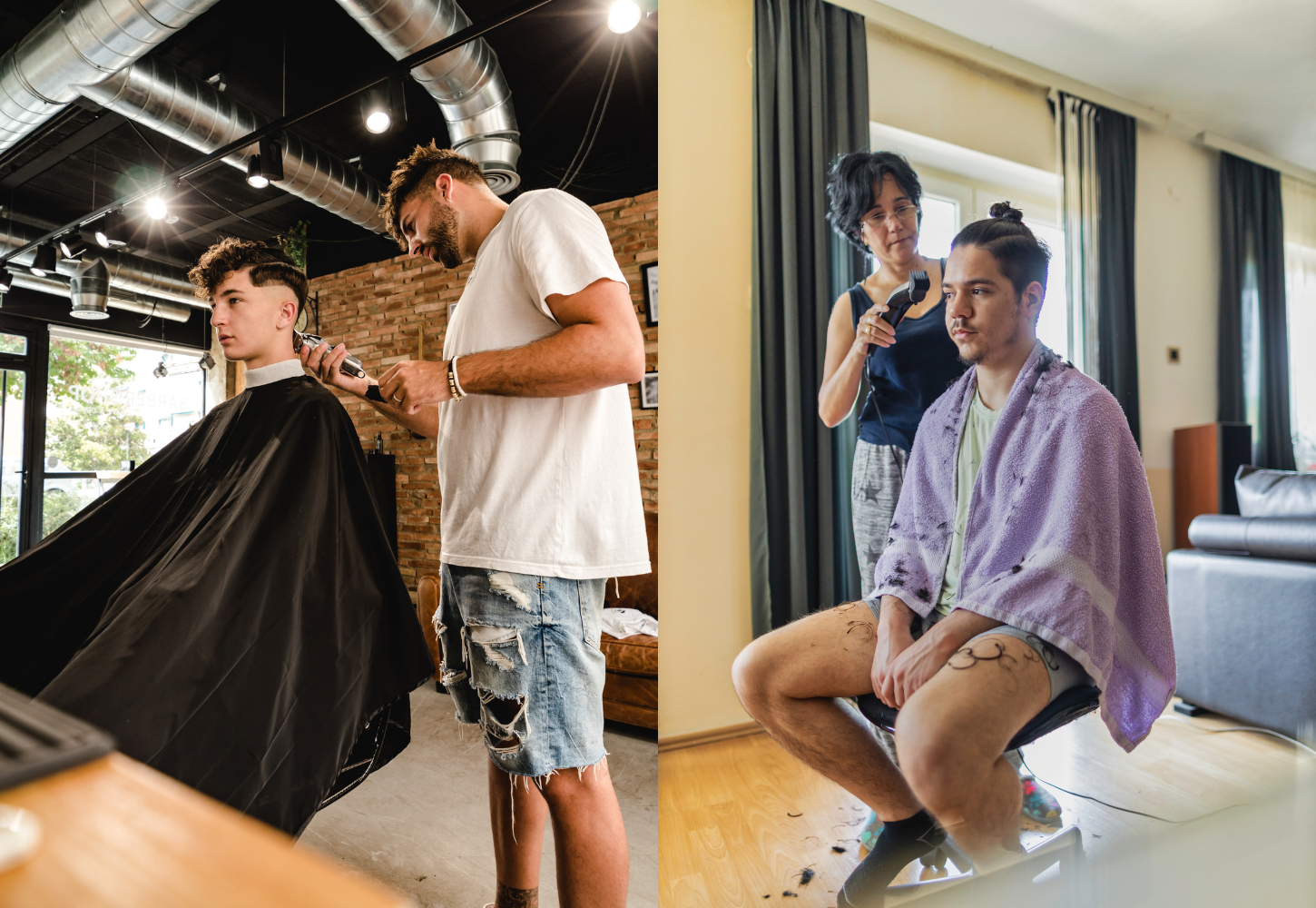
24% of Australians get their hair cut at home, by themselves or a family member, well below the 36% of Americans who do the same. Australians lean instead on the local independent salon or barber, named by 47% compared with just 29% of Americans. How often people get a cut looks broadly similar between the two countries, though Americans are more than twice as likely to say they never get a haircut at all (9% vs 3%).
Beyond that headline split, the two countries agree more than they disagree on the details. Price is the top reason for choosing a place in both markets, though Australians weight location almost as heavily while Americans lean more on the quality of the cut and trust in their stylist. The clearest brand story is in the tools: Wahl is the standout choice among Americans who cut hair at home (30%, more than double the next brand), while Australian home cutters are split fairly evenly across Remington, Wahl, Philips, and Braun.
How often do people get their hair cut?
Question 1: How often do you get a haircut?
Overall cadence looks similar between the two countries, but the tails differ. Americans are noticeably more likely to say they never get a haircut (9% vs 3%). Australians lean slightly more toward the middle of the scale, settling into a cut every 2-3 months, while Americans are a little more spread between monthly visits at one end and no fixed schedule at the other.
By segment
| Male n = 639 | Female n = 808 | Under 30 n = 179 | 30–55 n = 724 | Over 55 n = 544 | |
|---|---|---|---|---|---|
| Weekly or more | 3% | 0% | 1% | 2% | 1% |
| Every 2 weeks | 8% | 1% | 5% | 5% | 2% |
| Monthly | 22% | 4% | 12% | 12% | 12% |
| Every 6-8 weeks | 17% | 19% | 11% | 13% | 27% |
| Every 2-3 months | 23% | 20% | 24% | 19% | 23% |
| Three times a year | 7% | 13% | 13% | 10% | 10% |
| Twice a year | 5% | 14% | 11% | 11% | 7% |
| Once a year or less | 2% | 13% | 10% | 11% | 5% |
| No fixed schedule | 10% | 14% | 13% | 14% | 10% |
| I never get a haircut | 3% | 4% | 2% | 3% | 4% |
| Male n = 651 | Female n = 729 | Under 30 n = 237 | 30–55 n = 684 | Over 55 n = 459 | |
|---|---|---|---|---|---|
| Weekly or more | 5% | 1% | 2% | 4% | 1% |
| Every 2 weeks | 12% | 2% | 10% | 9% | 2% |
| Monthly | 25% | 8% | 13% | 17% | 16% |
| Every 6-8 weeks | 13% | 10% | 7% | 10% | 15% |
| Every 2-3 months | 16% | 13% | 14% | 11% | 20% |
| Three times a year | 4% | 9% | 7% | 6% | 9% |
| Twice a year | 5% | 12% | 9% | 8% | 10% |
| Once a year or less | 4% | 14% | 11% | 10% | 7% |
| No fixed schedule | 11% | 20% | 18% | 17% | 13% |
| I never get a haircut | 7% | 11% | 10% | 9% | 7% |
The gender pattern is identical in both countries: men keep the shortest, most frequent cycles (monthly or more), while women’s answers spread out toward longer gaps, no fixed schedule, or no haircut at all. Age tells a consistent story too. Over-55s in both countries are the most likely to settle into a longer but regular cycle, every 6-8 weeks in Australia (27%) and a mix of 6-8 weeks and 2-3 months in the US (15% and 20%), while Australian under-30s are the one segment where a 2-3 month rhythm is the clear favourite (24%).
Where do people get their hair cut?
Question 2: Where do you usually get your hair cut?
Asked of respondents who get a haircut at all (excludes those who never do).
The local independent salon or barber is by far the single biggest category in Australia (47%, roughly one in every two people), whereas in the United States it only narrowly leads a much more even field (29%), with home cutting by themselves close behind. Combine the two “at home” options and Australians sit at 24% versus 36% for Americans. Chain and franchise salons also play a bigger role in the US (16%), while high-end salons, mobile hairdressers and “it varies” land at almost identical levels in both countries.
By segment
| Male n = 621 | Female n = 780 | Under 30 n = 175 | 30–55 n = 703 | Over 55 n = 523 | |
|---|---|---|---|---|---|
| Local independent salon/barber | 48% | 46% | 38% | 43% | 54% |
| At home (by myself) | 19% | 10% | 15% | 14% | 14% |
| Chain/franchise salon | 10% | 14% | 13% | 12% | 12% |
| At home (family/friend) | 13% | 9% | 10% | 11% | 10% |
| It varies | 6% | 10% | 12% | 10% | 4% |
| High-end/premium salon | 3% | 8% | 11% | 7% | 2% |
| Mobile hairdresser | 1% | 2% | 2% | 2% | 2% |
| Other | 1% | 2% | 0% | 1% | 2% |
| Male n = 609 | Female n = 651 | Under 30 n = 214 | 30–55 n = 621 | Over 55 n = 425 | |
|---|---|---|---|---|---|
| Local independent salon/barber | 30% | 28% | 30% | 26% | 33% |
| At home (by myself) | 26% | 19% | 24% | 25% | 18% |
| Chain/franchise salon | 16% | 16% | 13% | 15% | 20% |
| At home (family/friend) | 13% | 15% | 15% | 13% | 15% |
| It varies | 7% | 9% | 11% | 10% | 4% |
| High-end/premium salon | 5% | 9% | 4% | 9% | 7% |
| Mobile hairdresser | 2% | 3% | 2% | 2% | 2% |
| Other | 1% | 1% | 1% | 1% | 1% |
Age cuts in opposite directions on independent salons. In Australia, reliance on the local independent salon or barber rises steadily with age, climbing from 38% of under-30s to 54% of over-55s, the single strongest segment result in the whole survey. In the United States, the pattern is flatter, and it’s chain or franchise salons that grow with age instead (13% of under-30s to 20% of over-55s). On self-cutting, men lead in both countries (19% in Australia, 26% in the US), and in both countries over-55s are the age group least likely to cut their own hair at home.
Why do people choose that place?
Question 3: What's the main reason(s) you choose that place? (Select all that apply.)
Asked of respondents who get a haircut outside the home.
Price tops the list in both countries at almost identical levels, but the order shifts after that. Australians rank location just behind price (49%, only 2 points off top spot), a convenience-first mindset that fits with how often they name the local independent salon as their usual place. Americans instead put more weight on the quality of the cut (41%), location (40%), and trust in a specific stylist (37%, about 7 points higher than Australia).
By segment
| Male n = 445 | Female n = 663 | Under 30 n = 136 | 30–55 n = 552 | Over 55 n = 420 | |
|---|---|---|---|---|---|
| Price | 52% | 50% | 46% | 49% | 55% |
| Location/convenience | 52% | 46% | 38% | 44% | 58% |
| Quality of the haircut | 42% | 37% | 38% | 36% | 42% |
| Trust in a specific stylist | 24% | 35% | 28% | 29% | 33% |
| Booking ease | 21% | 20% | 21% | 20% | 22% |
| Ambience/experience | 12% | 10% | 13% | 13% | 8% |
| Recommendation | 7% | 11% | 17% | 11% | 5% |
| Loyalty program or membership | 5% | 2% | 8% | 3% | 2% |
| Other | 3% | 2% | 0% | 2% | 3% |
| None of the above | 3% | 4% | 3% | 3% | 4% |
| Male n = 415 | Female n = 509 | Under 30 n = 155 | 30–55 n = 449 | Over 55 n = 320 | |
|---|---|---|---|---|---|
| Price | 49% | 50% | 47% | 49% | 52% |
| Location/convenience | 43% | 37% | 34% | 38% | 44% |
| Quality of the haircut | 44% | 38% | 46% | 35% | 47% |
| Trust in a specific stylist | 33% | 40% | 38% | 34% | 41% |
| Booking ease | 23% | 19% | 23% | 19% | 23% |
| Ambience/experience | 14% | 11% | 15% | 14% | 9% |
| Recommendation | 11% | 12% | 21% | 11% | 8% |
| Loyalty program or membership | 6% | 5% | 8% | 6% | 4% |
| Other | 1% | 1% | 1% | 1% | 2% |
| None of the above | 9% | 12% | 10% | 13% | 9% |
The clearest finding in this comparison holds in both countries: over-55s lead on every “considered, experience-based” reason, price, location, quality and trust in a specific stylist, while under-30s lead on the two more socially-driven reasons, recommendation from friends or family and loyalty programs. Gender is consistent too: women weight trust in a specific stylist noticeably more than men (Australia: 35% vs 24%; United States: 40% vs 33%), while men lean harder on price and location.
What brand of clippers or trimmers do home cutters use?
Question 4: You mentioned that you get your hair cut at home. Which brand of clippers, trimmers, or hairdressing tools do you mainly use?
Asked of respondents who said they cut their hair at home, by themselves or a family member. Brand lists differ slightly between markets to reflect locally available products.
n = 339
n = 456
This is where the two countries look most different. Wahl is the clear market leader among American home cutters, named by 30%, more than double the next brand (Conair, 12%). Australian home cutters show no such standout: Remington, Wahl and Philips sit within three points of each other at the top, and the top brand only just clears 15%. The share who don’t use a specific brand at all is similar in both countries (Australia 31%, United States 27%), so the difference isn’t really about brand awareness overall, it’s that Americans who do have a brand of choice have mostly converged on the same one.
By segment
| Male n = 194 | Female n = 145 | Under 30 n = 43 | 30–55 n = 172 | Over 55 n = 124 | |
|---|---|---|---|---|---|
| Remington | 21% | 6% | 7% | 16% | 15% |
| Wahl | 19% | 5% | 0% | 13% | 17% |
| Philips | 14% | 10% | 26% | 13% | 7% |
| Generic/no-name brand | 7% | 17% | 16% | 11% | 9% |
| Braun | 14% | 3% | 7% | 6% | 15% |
| Panasonic | 6% | 4% | 5% | 6% | 4% |
| BaByliss | 1% | 1% | 0% | 1% | 1% |
| Andis | 0% | 1% | 0% | 1% | 0% |
| Other | 3% | 6% | 2% | 4% | 5% |
| I don't use a specific brand tool | 18% | 48% | 37% | 30% | 29% |
| Male n = 236 | Female n = 220 | Under 30 n = 82 | 30–55 n = 235 | Over 55 n = 139 | |
|---|---|---|---|---|---|
| Wahl | 45% | 14% | 18% | 34% | 30% |
| Conair | 8% | 16% | 16% | 14% | 7% |
| Generic/no-name brand | 7% | 11% | 7% | 9% | 9% |
| Remington | 7% | 5% | 5% | 6% | 7% |
| Philips Norelco | 9% | 1% | 5% | 5% | 5% |
| Panasonic | 3% | 4% | 11% | 3% | 1% |
| Andis | 5% | 1% | 2% | 4% | 0% |
| Oster | 3% | 3% | 1% | 2% | 5% |
| Other | 2% | 3% | 0% | 1% | 6% |
| I don't use a specific brand tool | 13% | 43% | 34% | 23% | 32% |
Gender is the clearest divide in both countries: men who cut hair at home are far more likely to name a specific brand, while roughly half of women (Australia 48%, United States 43%) say they don’t use a specific brand tool at all. Where men do name a brand, the two countries land on different winners, Wahl leads comfortably among American men (45%), while Australian men split fairly evenly between Remington (21%), Wahl (19%) and Philips/Braun (14% each). Age shows one quirky standout in each country: Australian under-30s are unusually drawn to Philips (26%, the highest single result on this whole table) and named no Wahl usage at all, while American under-30s are the only age group to give Panasonic a real foothold (11%, versus 4% or less among older Americans).
Implications
On the surface, Australians and Americans get their hair cut at a similar pace, and price is the top consideration for both. But the similarities stop there. Australians are loyal to the local independent salon or barber, a habit that strengthens with age and drives their emphasis on location as a reason for choosing where to go. Americans are far more willing to do it at home, and when they do reach for a brand, they overwhelmingly reach for the same one, Wahl. Australian home cutters, by contrast, have no dominant brand, spreading their loyalty across Remington, Wahl, Philips, and Braun in roughly equal measure. Whether that reflects a more entrenched hairdressing culture in Australia, price sensitivity in the United States, or simply how each market’s clipper brands have marketed themselves, the result is two very different pictures of how a routine trim actually gets done.